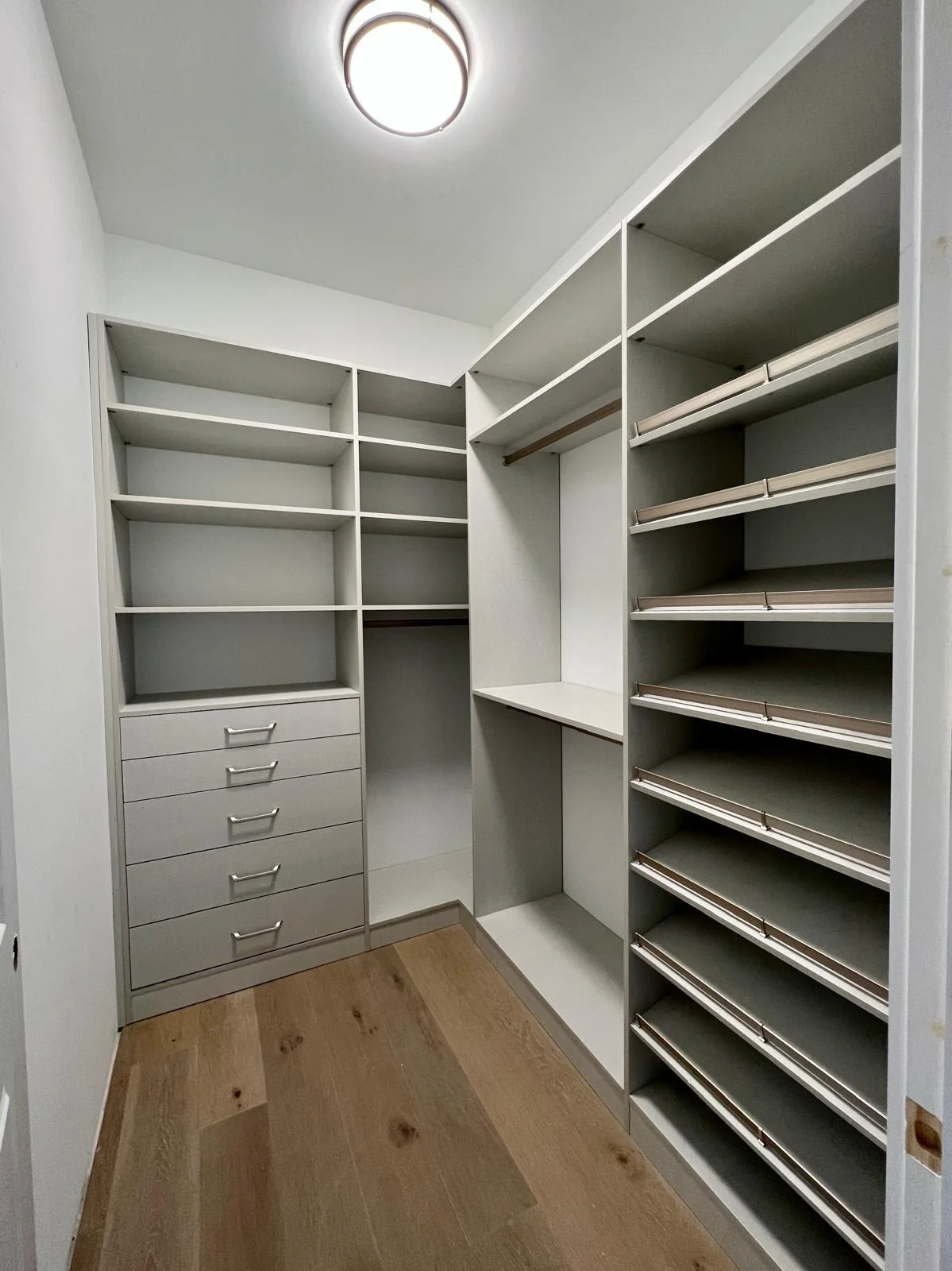
The best shoe and handbag storage starts with your collection, not a standard wall of identical shelves. Group everyday shoes, taller footwear and bags by size and frequency of use. Then plan storage that lets you remove one item without shifting several others. For a Delray Beach closet, the goal is a space that works just as well for everyday sandals as it does for occasion shoes and a favorite handbag.
What should you count before planning shoe and handbag storage?
Count shoes in pairs and separate them into categories: flats and sandals, sneakers, heels, ankle boots and taller boots. Set aside pieces you no longer use before planning permanent space for them.
For handbags, separate small evening bags, everyday shoulder bags, structured bags and larger totes. Note which items need their own space and which can share a shelf without being pressed together. If you store a bag in a dust bag, include that covering when considering how much room it needs.
A useful inventory includes three details for each group: how many you own, which items you reach for most, and which are unusually tall, wide or deep. This is more useful in an initial design conversation than a photo of someone else's perfectly styled display.
How do you plan shelf spacing without wasting room?
Use representative items from your own collection. Place your widest everyday pair together, then check a taller heel or boot separately. For bags, consider the body, handles and any covering or support you normally use.
Leave enough clearance to lift an item out comfortably. A shelf that technically holds a bag may still be awkward if the handles catch on the shelf above it. Similarly, pairs packed tightly together can be difficult to put away without rearranging their neighbors.
Avoid choosing a universal shelf height or a claimed pairs-per-shelf capacity before the items and available space have been checked. Shelf depth, usable width, supports and the shape of your footwear all affect the final layout. If adjustability would be helpful, raise it during design planning; specific components and availability need confirmation.
For a smaller opening, our reach-in closet guide for Boynton Beach homes explains why accessible storage matters as much as the amount you can fit inside.
Should shoe shelves be flat or angled?
Start with the way you want to use them. A flat shelf can provide a simple place to line up everyday pairs. An angled display may make a favorite collection easier to view, but the slope, retaining detail and actual shoe shapes need to work together.
Before deciding, ask a practical question: can you take out and return the shoes you wear most without catching a heel, nudging another pair or bending awkwardly? Where feasible, use your own footwear when evaluating a proposed arrangement.
Do not choose a display treatment purely because it photographs well. A shelf that suits one type of shoe may not suit every item you own. The closet photos on our site show design options, not a promise that every pictured component is appropriate or available for every project.
How should handbags fit into the storage plan?
Give each bag enough room to rest in its intended storage position. Do not make a narrow opening work by compressing the bag or bending its handles. Plan larger totes separately from smaller structured bags rather than expecting every piece to fit the same compartment.
The Canadian Conservation Institute's guidance on caring for leather objects recommends sufficient storage space to avoid compression and creasing. It also warns against overstuffing shape supports. That guidance concerns museum collections, not a household care prescription, but it reinforces a useful planning principle: provide room rather than forcing a leather item to fit.
For your own handbag, follow its maker's instructions on storage position, support and coverings. Different leathers, linings and decorative details can require different care. A closet design should accommodate that routine, not replace it.
Should you display everything or keep some pieces covered?
Choose visibility where it genuinely helps you get dressed. Keep the pairs you use frequently easy to identify and return. You may prefer covered storage for occasional pieces, particularly when their makers recommend it. A small, considered display can be more useful than exposing the entire collection.
For example, leather-goods maker Tsuchiya Kaban recommends breathable dust bags rather than plastic bags for its leather bags, and advises keeping them out of direct sunlight and strong lighting. Read its leather bag storage guidance, then check the instructions for the brands and materials you own.
If a closet has a window or you are considering display lighting, mention that early. Do not assume that a glass door or attractive cabinet makes every display position suitable for leather.
What makes the arrangement practical for daily life in Delray Beach?
Think through the return trip as well as the morning routine. Where do your everyday sandals go when you come home? Can you put a work bag away without unloading a shelf? Do occasional shoes crowd out the pairs you actually wear?
Keep your most-used categories in comfortable reach and group occasional items separately. Plan a distinct place for taller footwear rather than allowing it to interrupt every shoe shelf. If two people share the closet, divide storage around their collections rather than assuming both need identical sections.
For a walk-in, shoe and bag storage must also leave the room easy to move through. Our Boca Raton walk-in closet guide discusses circulation and shared storage. New shelving should support that overall layout, not take priority over it.
How do you start planning your own shoe and handbag storage?
Take a few photos of the existing closet and make a short inventory of shoes and bags. Identify your two biggest frustrations, plus any pieces that are difficult to fit. You do not need a finished design or professional measurements to begin the conversation.
Explore Coco Bianco custom closet design options, then request a complimentary 15-minute phone consultation. Submit the request form and our team will contact you to arrange the call. The form does not automatically book an appointment. Measurements and any in-home visit come later, if appropriate.
Request My Phone Consultation.
Common Questions
How much shelf space should I allow for shoes?
Base the layout on your own pairs rather than a universal capacity estimate. Check the widest pair, taller footwear and the clearance needed to remove and return items. Final shelf dimensions depend on the usable space and selected components.
Are angled shoe shelves better than flat shelves?
Neither is automatically better. Flat shelves can offer straightforward everyday storage, while an angled arrangement may improve visibility. Check how your actual footwear sits and how easily you can remove it before choosing a treatment.
Should every handbag have its own compartment?
Not necessarily. Some bags can share a shelf if they have enough room and are not compressed. Plan around their shapes, handles, coverings and individual maker care instructions rather than using one compartment size for the whole collection.
Can a handbag display replace a dust bag?
Do not assume so. Follow the handbag maker's guidance on coverings, light exposure and storage. A visually appealing cabinet does not automatically provide the conditions or protection a particular bag needs.
Can shoe and handbag storage work in a reach-in closet?
It can be part of a reach-in plan, but it must share the available space with hanging and folded storage. Prioritize what you use most and confirm that the closet opening lets you reach the proposed shelves comfortably.
Is the first Coco Bianco consultation an in-home appointment?
No. The first step is a complimentary 15-minute phone consultation. Submit the request form and the team will contact you to arrange the call. Measurements and any in-home visit come later if appropriate.
Your Next Step
Let’s talk about your closet.
Request a complimentary 15-minute phone consultation. Our team will contact you to arrange the call. This is not an automatic booking or an initial in-home visit.
Request My Phone Consultation